Ohm's Law Made Simple: V = I × R, Power, and Why Resistors Burn
Voltage, current and resistance are linked by one equation. Learn Ohm's law with real circuit examples, the power formula that tells you which resistor wattage to buy, and the mistakes that make components smoke.
Nearly every calculation in a beginner electronics project comes back to one relationship:
V = I × R
Voltage (V, in volts) equals current (I, in amperes) times resistance (R, in ohms). If you know any two of them, you can find the third. This article explains what each quantity actually means, works through examples from real projects, and then adds the second equation that beginners usually skip: power.
The three quantities
Voltage is the electrical "pressure" difference between two points. A 9 V battery has 9 V between its terminals. Voltage is always measured between two points, never at one point alone. When someone says "this pin is at 3.3 V", they mean 3.3 V relative to ground.
Current is the rate of charge flowing through a point, measured in amperes (A). Small circuits work in milliamps (mA): an LED typically runs at 5–20 mA, and a microcontroller board draws tens of mA.
Resistance is how strongly something opposes current, measured in ohms (Ω). A resistor's whole job is to provide a known, fixed resistance.
The water-pipe analogy works well for a first intuition. Voltage is the water pressure, current is the flow rate, and resistance is how narrow the pipe is. Higher pressure pushes more flow, and a narrower pipe lets less through.
Rearranging the equation
The same law in three forms:
- V = I × R — find voltage
- I = V ÷ R — find current
- R = V ÷ I — find resistance
The triangle trick helps: write V on top, and I and R side by side on the bottom. Cover the one you want, and what's left shows the operation. Covering I leaves V over R, so I = V/R.
Watch your units. The equation works in base units: volts, amps and ohms. 20 mA is 0.020 A, and 4.7 kΩ is 4700 Ω. Most wrong answers in our workshop quizzes are off by exactly 1000 because someone mixed mA and A.
Worked examples
1. How much current flows through a 1 kΩ resistor on 5 V? I = V / R = 5 / 1000 = 0.005 A = 5 mA.
2. A sensor draws 15 mA from a 3.3 V supply. What is its effective resistance? R = V / I = 3.3 / 0.015 = 220 Ω.
3. You measure 2.1 V across a 470 Ω resistor. What current flows through it? I = 2.1 / 470 = 4.5 mA. This is a handy trick: measuring the voltage across a known resistor tells you the current without breaking the circuit to insert an ammeter.
The part beginners skip: power
Every resistor turns electrical energy into heat. The power it dissipates, in watts, is:
P = V × I
Substituting Ohm's law gives two more useful forms:
- P = I² × R
- P = V² ÷ R
Common through-hole resistors are rated ¼ W (0.25 W). Exceed that and the resistor gets hot, discolours, and eventually fails. Sometimes it fails open, and sometimes it fails with a smell everyone in the lab will remember.
Example: connecting 12 V directly across a 100 Ω resistor. I = 12 / 100 = 0.12 A, and P = 12 × 0.12 = 1.44 W. That's almost six times what a ¼ W resistor can handle. You'd need at least a 2 W part, and in practice a design that doesn't waste 1.44 W as heat.
Example: LED resistor on 5 V. A 150 Ω resistor drops 3 V at 20 mA: P = 3 × 0.020 = 0.06 W. A ¼ W resistor is fine, with plenty of margin.
A good rule of thumb is to choose a resistor rated for at least twice the power you calculate. Parts rated exactly at their limit run hot and drift.
Series and parallel in one paragraph
Resistors in series add up: R = R1 + R2. Resistors in parallel combine to less than the smallest one: 1/R = 1/R1 + 1/R2. For two equal resistors in parallel, the result is half of one of them. Two 1 kΩ resistors in parallel give 500 Ω, which also share the power between them. That's a useful trick when the only resistors in the drawer are ¼ W.
Where Ohm's law doesn't apply directly
Ohm's law describes linear components, where current is proportional to voltage. Resistors and wires follow it. Several common parts don't:
- LEDs and diodes have a roughly fixed forward voltage. Once it's exceeded, current rises very steeply, which is exactly why they need a series resistor.
- Motors draw a large current when stalled or starting, and much less when spinning freely.
- Filament lamps have a resistance that rises a lot as they heat up.
For these, you apply Ohm's law to the resistor in the circuit, not to the non-linear part itself. That's what the LED resistor guide does.
Checking your maths with a meter
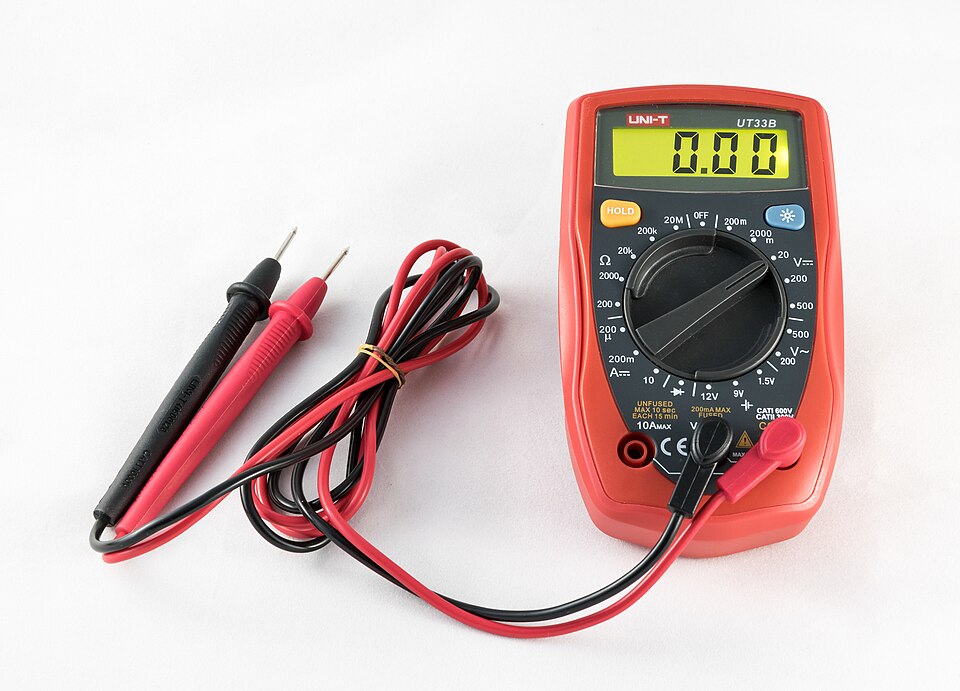
Theory and the real circuit should agree within the resistor tolerance. If you calculate 5 mA and measure 50 mA, something is wired wrong. The most likely cause is a resistor of the wrong value: 100 Ω read as 1 kΩ is a classic. See our resistor colour code guide and the multimeter guide for how to measure each quantity safely.
Try it
Plug in your own numbers with the free Ohm's Law calculator. It solves for whichever value you leave blank. Ohm's law is taught interactively on Day 1 of the ElectroLab course, along with the multimeter and breadboard.
References
- SparkFun, Voltage, Current, Resistance, and Ohm's Law: learn.sparkfun.com
- All About Circuits, Ohm's Law (Lessons in Electric Circuits, Vol. I, Ch. 2): allaboutcircuits.com
- SparkFun, Resistors (power ratings and series/parallel combinations): learn.sparkfun.com