How to Read Resistor Color Codes: 4, 5 and 6-Band Resistors Explained
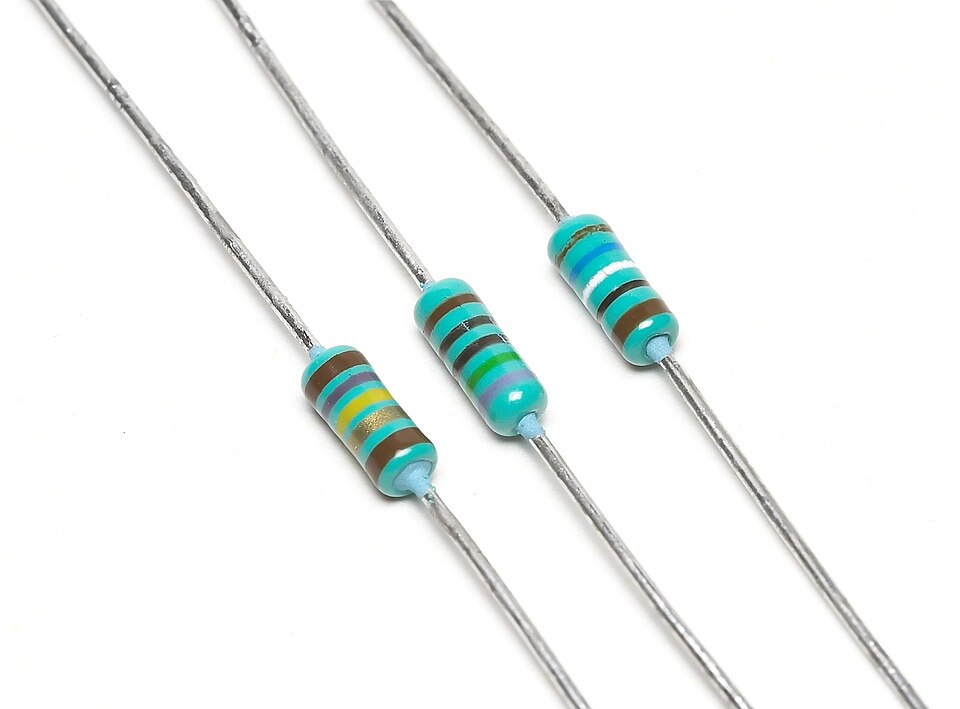
Resistors don't print their value — they wear coloured bands. Learn to read 4, 5 and 6-band resistors, which end to start from, what tolerance means, and why the values you can buy are 4.7k and 2.2k instead of round numbers.
Pick up a through-hole resistor and you won't find "220 Ω" printed on it. The body is too small and too round for readable text, so the value is encoded as coloured rings instead. In our workshops this is the first thing that slows beginners down: the kit has twenty resistors in a bag, they all look the same, and the circuit only works if you pick the right one.
This guide covers how the code works, how to read it from the correct end, and the habits that stop you from mixing up a 1 kΩ and a 10 kΩ at 11 pm before a project deadline.
The colour-to-digit table
Every colour stands for a digit from 0 to 9. The order follows the rainbow, with black and brown at the start and grey and white at the end:
| Colour | Digit | Multiplier | Tolerance |
|---|---|---|---|
| Black | 0 | ×1 | — |
| Brown | 1 | ×10 | ±1% |
| Red | 2 | ×100 | ±2% |
| Orange | 3 | ×1 k | — |
| Yellow | 4 | ×10 k | — |
| Green | 5 | ×100 k | ±0.5% |
| Blue | 6 | ×1 M | ±0.25% |
| Violet | 7 | ×10 M | ±0.1% |
| Grey | 8 | — | ±0.05% |
| White | 9 | — | — |
| Gold | — | ×0.1 | ±5% |
| Silver | — | ×0.01 | ±10% |
A common memory aid is to remember that the multiplier band is just "how many zeros to add". Red as a multiplier means two zeros, orange means three, and so on. Gold and silver are the exceptions: they move the decimal point left, which is how you get values below 10 Ω.
Reading a 4-band resistor
Four-band resistors are the most common type in beginner kits. They are usually ±5% carbon-film parts.
- Band 1 — first digit
- Band 2 — second digit
- Band 3 — multiplier
- Band 4 — tolerance (usually gold)
Example: red, red, brown, gold. Red = 2, red = 2, brown = ×10. That gives 22 × 10 = 220 Ω, ±5%. This is the resistor you'll use most often in front of an LED on a 5 V Arduino.
Example: brown, black, orange, gold. 1, 0, ×1000 = 10 kΩ. This is the classic pull-up resistor value.
Example: yellow, violet, red, gold. 4, 7, ×100 = 4.7 kΩ, the usual pull-up for an I²C bus.
Reading 5-band and 6-band resistors
Precision resistors, usually ±1% metal-film parts with a blue body, use three digit bands instead of two:
- Bands 1–3 — three digits
- Band 4 — multiplier
- Band 5 — tolerance (often brown = ±1%)
Example: brown, black, black, brown, brown. 1, 0, 0, ×10 = 1 kΩ, ±1%.
A sixth band, when present, gives the temperature coefficient: how much the resistance drifts as the part heats up, in parts per million per kelvin. Brown is commonly 100 ppm/K and red 50 ppm/K. You'll only care about this in measurement or precision analog circuits.
Which end do I start from?
This is the question we get asked most. Some clues, in order of reliability:
- Gold or silver is almost never the first band. If one end has a gold band, start from the other end.
- The tolerance band is often spaced a little further away from the others.
- The first band is usually closer to the lead.
- Sanity-check the result against standard values (next section). If reading one way gives 4.7 kΩ and the other way gives 72 Ω, the standard value is the correct reading.
When it's still ambiguous, and with faded or burnt bands it often is, measure it.
Why resistor values look "random"
You can buy a 4.7 kΩ resistor but not a 5 kΩ one. That's because values are taken from the E-series of preferred numbers, which space values evenly on a logarithmic scale so that tolerance bands overlap.
The E12 series (12 values per decade, for ±10% parts) is:
10, 12, 15, 18, 22, 27, 33, 39, 47, 56, 68, 82
The E24 series (24 values per decade, for ±5% parts) contains all of E12 plus 12 more, such as 11, 13, 16, 20, 24, 30, 36, 43, 51, 62, 75 and 91. Precision series such as E96 go much finer.
Every value repeats in each decade, so 47 Ω, 470 Ω, 4.7 kΩ and 47 kΩ all exist. When a calculation tells you that you need 180.3 Ω, you pick the nearest standard value. For a current-limiting resistor, you usually round up to the next value so the current ends up slightly lower, not higher.
What tolerance actually means
A 1 kΩ ±5% resistor can measure anywhere between 950 Ω and 1050 Ω and still be in spec. For an LED current-limiting resistor this doesn't matter at all. For a voltage divider that feeds an ADC and is supposed to measure battery voltage, ±5% on each of two resistors can put your reading off by several percent. In that case use ±1% parts, or calibrate in software against a multimeter reading.
Measure, don't guess
A multimeter set to resistance (Ω) settles any doubt in two seconds. A few rules:
- Measure the resistor out of the circuit. In a circuit, other components in parallel change the reading.
- Don't hold both probe tips with your fingers. Your body is roughly a few hundred kΩ to a few MΩ in parallel, which corrupts readings of high-value resistors.
- On a manual-range meter, start on a higher range and work down.
If you're new to the meter itself, our multimeter guide covers voltage, current and continuity mode as well.
Habits that save time
- Sort your kit once. Label strips of tape or small bags with the value. Most of our workshop kits only need 220 Ω, 330 Ω, 1 kΩ, 4.7 kΩ and 10 kΩ.
- Learn the five common ones by sight. Red-red-brown (220 Ω), orange-orange-brown (330 Ω), brown-black-red (1 kΩ), yellow-violet-red (4.7 kΩ) and brown-black-orange (10 kΩ) cover most hobby circuits.
- Check under good light. Red, orange and brown look very similar under warm lighting, and that confusion is behind most misreads.
Try it
Use our free Resistor Colour-Code decoder to click through bands and see the value, or go the other way from value to bands. You'll meet resistors properly on Day 1 of the ElectroLab course, and the next step is using them: see How to Choose an LED Resistor and Ohm's Law Made Simple.
References
- Vishay, Resistor Colour Code and E-series preferred values (IEC 60063): vishay.com
- SparkFun, Resistors tutorial: learn.sparkfun.com/tutorials/resistors